
Living Things
All the Biggies

I met Ruby Cohen today, a young woman who wants to change the culture around death. She has a company called Cafe Mortel that creates memorials or after death experiences. We talked about how creepy mortuaries are, in particular, the showrooms of caskets, all the varieties of dull sheen and gleaming wood, row upon row, all with the padded satin interiors, complete with pillow?!
I think she has a point, that the whole approach is a bit off and weird, and hasn’t progressed much in hundreds of years.
Ruby is also an artist who single-handedly designed an immersive death-awareness dinner that featured a simulated flight to “the end,” your final destination, with flight attendants, chef-made meal on trays—different ones for coach and first class—boarding passes, the whole works. The event ended with a group conversation; all the guests discussing their thoughts, feelings, fears and experiences with death. My friend went, and said it was extraordinary and inspiring. When she invited to have lunch with the person who dreamed up such a thing, as well as launching a deathstyle brand, I was all in.
Swiss sociologist Bernard Crettaz came up with the original Cafe Mortels, and though I’ve not done a thorough deep dive, at some point Death Cafes began to appear, meet-ups where people go to talk about death over tea and cake. These are happening around the world, and I’ve learned in the UK there are regular and on-going Death Cafes. It’s part of the death positivity movement, which also traces roots to an American undertaker, Caitlin Doughty, and to cultural anthropologist Ernest Becker. The latter has a book, The Denial of Death, which makes a case for an idea I have long believed: that people rely upon a myriad of neuroses, addictions, and behaviors to cope with the fear of death.
It’s all immensely interesting to me. I wouldn’t describe myself as morbid, but I have jags of preoccupation with death, going back to my childhood. Often, when someone dies unexpectedly, I can be ghoulishly obsessive for hours, reading and searching about what happened, how it happened, what and when their last social media was. I don’t know if I’m the only person who does this, I hope not.
I’ve had a peripheral proximity to murder only a handful of times. This is the absolute worst way to die I believe, at the hand of an evil person, whether by random wrong place/wrong timeliness or by orchestrated targeting. Recently a beloved and well known man in our neighborhood lost his 21-old-son to murder in Primrose Hill, a beautiful spot in one of the best locales in London. Another friend of mine lost her sister to an assailant who she not only knew, but lived with. There have been some other few-degrees of separation from me and a murder victim in my life, just enough to jolt me out of the complacency that such things don’t happen in “my” world. They do. As do freak accidents, car crashed, illnesses.
It’s all so disturbing and upsetting, it’s no wonder we are all a bit nuts. When I see animals doing a much better job at being animals than humans manage to do at being humans, I usually think, yeah, well they don’t wake up every day knowing it might be their last day. That’s not the first thought I have by any means, but it’s an undercurrent.
The awareness of mortality is a curse that our culture has done very little to assuage. With what’s probably an expected level of existential dread taking up more space in my head, I’ve been inclined lately to dig in and face it. Shining some light on those dark thoughts and fears in the hopes that a calm and peaceful acceptance can become the default. Maybe a Death Cafe meetup is in my future, but I’m also relying a lot on Zen Buddhist concepts of impermanence and transience.
As an aside, my last song I wrote this week for Psycher is called “Living Thing” —in case you had decided from all this that I operate in an entirely macabre sphere. I don’t.
Even though things keep lining up to keep me busy, and there’s always music to write and record, essays and outlines to get on the page, the endless loose ends always flapping about—I had to admit the other night (admit to a page, per some erratic journal writing) that I feel a bit purposeless in life. Moving to England, the great geographical shake-up, hasn’t eradicated this sense of uncertain searching. I can trace the onset to a series of biggies over the last five years…deaths, loss, pandemic, romantic break-up, empty nest, lack of paying work. In between all of that there were other big beautiful biggies that pushed those to the margins: graduations, awards, honors, festivals. But like everything, the biggies come and go, leaving maybe an even more flattened life landscape to traverse.
Maybe, I wonder, there’s something about adjacency to another person you love or are bonded that gives purpose. There’s an identifier that comes with the adjacency: Hello world, see me? I’m a mother/wife/partner/girlfriend. I’m a bandmate/co-worker/boss. Etc and so forth. Without the adjacency of a person or people I can still say and think I’m lots of things, but identifiers feel more nebulous and empty without other people. Why is that?
Other people anchor us to a purposeful existence, and even if it’s not an immediate loved one, through service or community, an individual can find purpose. Writing is a strange one; the distance from the reader doesn’t prevent that human adjacency, but in terms of strong and clear purpose, it’s not ideal, and it happens after the fact really.
These are all streams of thoughts I have as I write this. I enjoy reading yours too:
Sorry, going back there. My fellow grievers will get it. I’ve had dreams featuring my deads, even my dad (2018, gone) came to me in one. It wasn’t particularly warm and fuzzy, in the dream, he was telling me he was dying and I was sad but stoic, which pretty much sums up my core inner child. And I’ve been thinking about my mom, a lot. These thoughts are loaded with excess guilt, which is a nonsensical useless waste of regret and remorse because anyone who knew me and my mom will say I did nothing to warrant guilt. But there you have it. And as things go, I was looking for a me photo to use for an event I have in November, and came across this one of my young mom. She’s the blonde on the right. I love it.
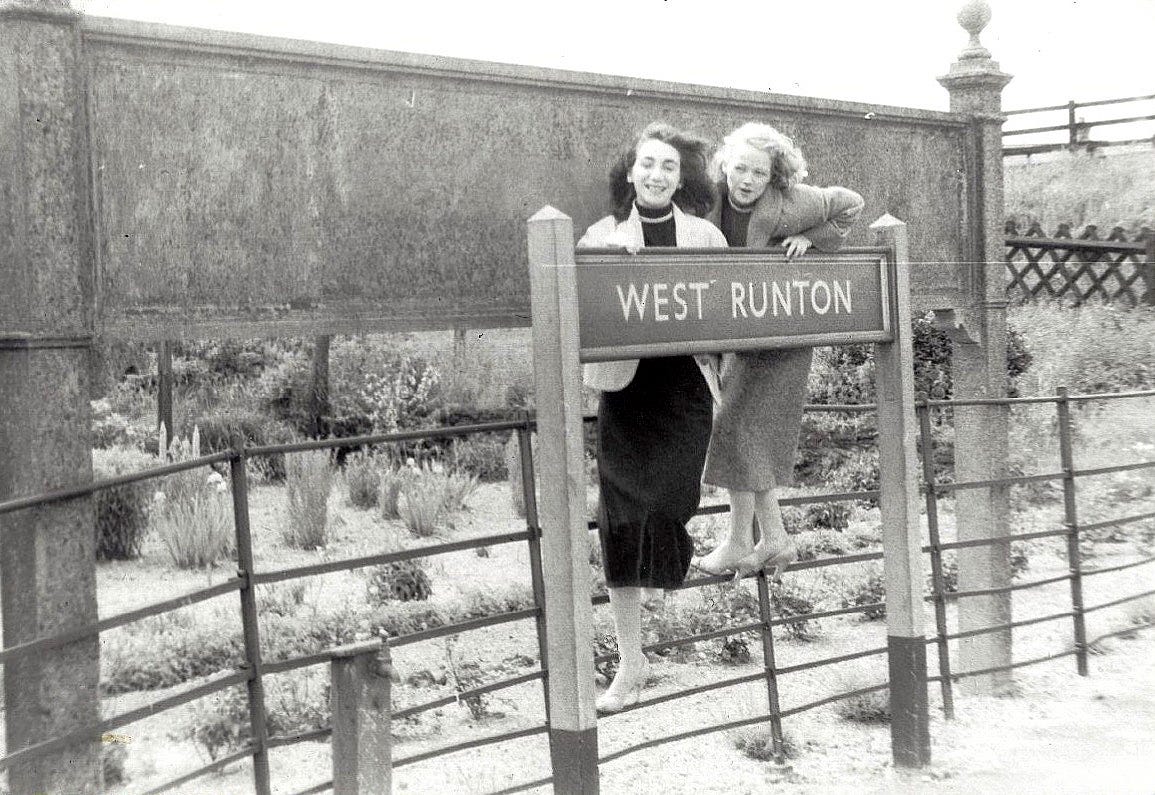
I've never heard of West Runton. The map says it’s on the coast in Norfolk. A three hour train ride. I wish I could ask my mom about this, who was her friend, what was happening that day, why they went to the beach, how long did they stay. We didn’t talk enough about things I would have liked to talk about, and when I tried, she seemed to get confused. She wasn’t demented or senile, so I immediately think maybe she was confused because instead of judging her or being frustrated with her, I was interested in her. Then I feel guilty and bad again.
I’m really hard on myself. I’m going to go meditate and be nice to me today. Please do the same, let’s be adjacent and let loving kindness soften our fears and doubts. It’s the only way. xK

What a beautiful photo Kathy. You MUST come visit me and Eric, we live just a short car or train ride from West Runton. It's a wonderful spot, can probably even find the sign. x
That is a wonderful and thought provoking piece. Thank you. The photo of your Ma is beautiful. (And apropos of nothing, as a complete aside, the second time I saw Joy Division was at West Runton Pavilion! They were support on Buzzcocks' tour for their A Different Kind Of Tension LP.)