
Last Party for Mom

My mom would’ve been 89 years old today, she died just a month and four days before her 85th. She was really looking forward to that birthday. I’d promised her a birthday celebration brunch at Everly in Austin, for her and whoever she wanted to invite. She was buzzing over it, had picked out a new dress, new shoes, new handbag.
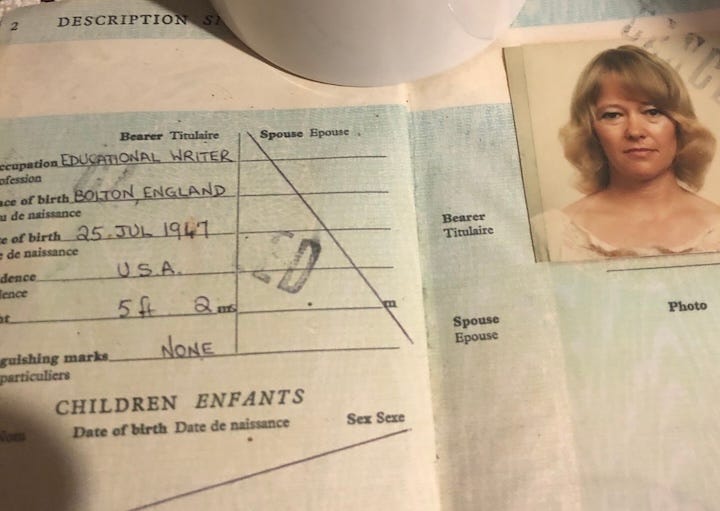
For the birthday that she didn’t make it to, I made it into a memorial event, at my house. I had it catered, made a long photo slide show that was projected onto a screen. I put some things on a table that I thought represented her: a scrabble game, some books she liked, her favorite jewelry, photos of her with one of her main loves, Ronald. One of the best things that represented her was a passport that she’d doctored her birth year, to make it 1947 instead of 1937. How on earth she got away with using that passport is beyond me.
I’d found a little thing with a quote on it, that summed my mom up perfectly, I put that on the table too. It said: “I believe that all wisdom in caring immensely for a few right things, and not caring a straw about this rest” —John Buchan
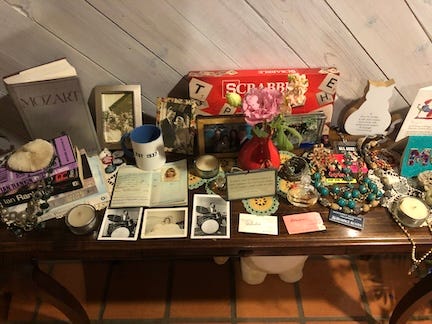


I wore the dress and shoes she’d chosen for her 85th birthday party. Friends and family dropped in for hours. Both Audrey and I spoke, her sister-in-law who came from England gave a speech that made Clem cry. I think he spoke too.
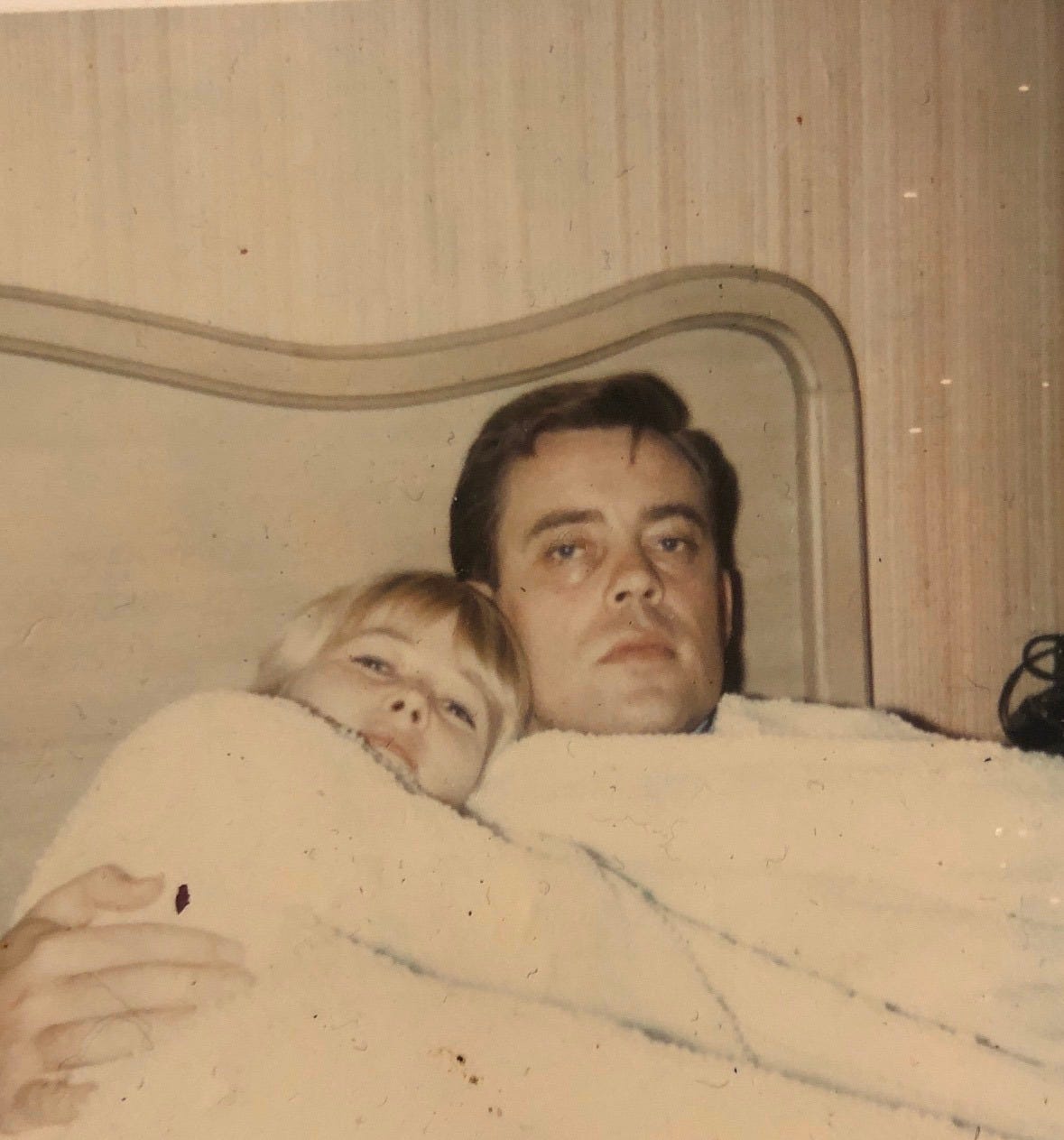
This is my mom with Ronald, who was her boyfriend from the time I was five to nearly twelve years old. He was charismatic, exerted a spell over people that did not escape my notice, even as a child. I was desperate for Ronald to care about me, but he kept me at a distance. The times I made him laugh are some of my most distinctive childhood memories. My mom was obsessed with Ronald. He kept her strung along all that time, never promising more, giving just enough to keep her from leaving him. She never had another substantial romantic relationship after that, for the rest of her life.

It’s an irony of sorts, how much my mom loved her birthday. When I was a kid, my birthdays were never celebrated with any fanfare. Only as an adult, when I got to make my own traditions, did I start going big with my birthday. And I carried the inclination to hers as well, always making sure she got a splashy event with friends and gifts. She loved being celebrated, she loved the idea of no other reason for something special happening other than her.
We all thought how much she would have loved her memorial event. Being seen, appreciated, spoken of.
Four years after dying, my mom is still a huge part of my life, my therapy life I should say. The ties are strong, and laced with a bit of toxic twist. Maybe it was impossible to work through it when she was alive, but it still weirds me out that she could have such a main character energy in my life when she’s physically gone. The other day in a session I spoke of how angry I was at her. And as soon as I said it, I could feel her presence, not in a way that brought about guilt, not in any way that she would have been were she alive. Just this benign presence.
In my book, I wrote about all of the things. The zero boundaries, the recklessness. I wrote about her leaving me alone, terrified. About her having an affair with my 16-year-old guy friend who I called “James” in the book. About her heroin addicted prison escapee drug dealing biker boyfriend —who also showed me my first rocknroll stuff on guitar. About our mom/daughter coke benders. I wrote about it fairly and matter-of-factly, I didn’t want to demonize her or make her the villain of my story because she wasn’t. The truth is, all of those things seemed normal to me, and I rolled with it all.
This is what I said to her: “Mom I have written ——— whatever it was. Are you okay with that, because, let me make this clear, I do not have to put it in the book. My book, my story will be great without this. If you don’t want me to put this in my book, I won’t.”
This is what she said back: “It’s your book, your story. You should write whatever you want in it.”
And that was when I realized and understood her more than I ever had. That was when I healed, a lot, and let go, a lot. That was when I knew, that for all the things she did that were harmful, dangerous, crazy, irresponsible—that there was one massive element I needed to embrace. She supported me, believed in me, and loved me, and in the ways that she could be, she was my mother.
My mom did not judge people, and thought people should be free to do as they chose. She really disliked the idea of rules, conventions, and she hated the idea of consequences for choices and decisions.
It’s a profoundly important shift that the bookwriting gave me. It changed my perspective towards her to a more open and appreciative recognition. I’m lucky I got to thank her for that, and tell her she was brave for letting me reveal so much. She really, really loved me and was so proud of me.
But man, it was, until the end, a really dysfunctional relationship, no matter how much work I did to have it not be.
Maybe one of the best things about love is that it can exist, and thrive and stay, even when the humans that are generating it are not capable of doing it perfectly. I’m not sure what perfect, ideal love is, but I’ve suspected for awhile, that to me, it’s wanting nothing but peace, happiness, and well-being for the person I love. In that way, my mom and I denied each other my notion of ideal love. She was never as happy as I wanted her to be, despite everything I did to try and provide the elements I thought would make her happiest. And the main thing she wanted from me was to be unconditionally accepted for who she was. But once I became a mom, it was too obvious where she had failed me. The entrenched relationship, of me as the adult and her as the child, became a dynamic that I resented and a role I was resistant to playing.
I think we all know what that’s like, when one person decides they’re kind of done with things being the way they are, and the other person doesn’t want it to change.
I’m learning how to recognize and repair the neural paths of reactive emotions that started in early childhood. This is good work, and it doesn’t really matter why it started or who made it that way. What matters is that I’m still healing and growing and forgiving and loving, and thinking of my mom. I’m thinking of her a lot today. As I went out to do some errands, butterflies and moths kept finding me, circling around my personal space and then flitting off. More than usual. It made me smile, and I said hi mom, each time.
Happy 89th birthday to Margaret Valentine. I love you and hope you are enjoying the freedom to be whoever you want to be. That makes me happy.
So I’m reading this while traveling home from NYC to CT on MetroNorth, sobbing my eyes out, which is fine because, for one thing, I got a seat (because everyone seems to be a little concerned about the tears running down my face and the fact that I’m using my sleeve because I don’t have a tissue). There are not a lot of Substack essays that I save, although I’ve saved many of yours and this one will join them. This is the thing: complicated mother/daughter relationships travel down a lot of different paths, but it seems to me that those of us who write about them have to do so with some degree of narrative ambiguity, for all the reasons you say. We have to know them for who they were, as opposed to who we hoped they would be, and who they hoped we would be. We all come to the table with limitations both severe and less-so, and everything has to be normalized until they’re gone, and only then do we get to deal with the work of understanding that normalization exists because it’s the only way we can live with each other in real time. A blessing and a curse. The work is actually harder now that they’re gone, I think. Today, someone who knew both my mother and me said “You did a good job,” and I laughed through tears because I spent so long hearing my mother say I was a god-awful daughter, and my response was liquid self-flagellation that provided both relief and torture in equal measure. And now, letting go of that is another form of letting go of her.
The fact that you turned her birthday into a memorial celebration was stunning; wherever she is, Margaret Valentine is smiling down on you. 🙏🏻🩷
Hello Kathy,
What a meaningful and heartfelt tribute to your mother.
Examining one's relationship with one's parents after their passing always gives one a chance to reflect and gain a new perspective on one's own life.
My parents were born during the 1920s, struggled during the Great Depression, survived the World War (both were involved with the US military), and then raised, guided, and enjoyed their children and children's children. A familiar background to most of my generation. Of course it's the individual experiences that make these relationships special. Both parents lived into their nineties. Both had to work to support the family. Both dealt with their stubborn children (it was the Sixties, remember?). Both always argued with each other, but always remain united when came to raising their children. In their retirement years they continued to be argumentative but remained together.
I had my ups and downs with folks. But in the end I remain glad that I can always bring up the good times with them and smile.
Thanks for sharing.